


By Avery Yale Kamila akamila@mainetoday.com
Staff Writer
In foodie culture, eating local is all the rage. But few go as far as Luke Fuller and Cassi Madison. The recently engaged couple reached their one-year anniversary this week of eating a diet made up almost exclusively of Maine food.

Luke Fuller and Cassi Madison prepare a chili using all Maine ingredients in their West End kitchen. Fuller, who is an artist, created the artwork above the stove. The piece on the left depicts the late Jim Cook, who founded the Crown O'Maine Organic Cooperative.

Sweet and spicy tempeh salad with nasturtium garnish.
Fuller's work is included in a group show opening Friday at June Fitzpatrick Gallery, 112 High St., Portland. The show, "MECA Painters 10 Years Later," features artists who graduated from the Maine College of Art in 2001. It opens with a reception from 5 to 8 p.m. during the monthly First Friday Art Walk festivities.
"It's been a long year," Fuller said from the couple's cozy apartment kitchen in Portland's West End, where a chili composed of Maine beans, tomatoes and tempeh simmered on the stovetop and stuffed squash baked in the oven.
"We started out being really strict," said Fuller, produce manager at Lois' Natural Marketplace in Scarborough.
But they relaxed a bit as the year progressed, allowing for the occasional coffee or restaurant meal. Fuller estimates they ended the year eating a diet made up of 90 percent local food.
On the first day of the local eating adventure, Fuller and Madison showed this isn't a deprivation diet. Their meals that day included a kale, onion, Gouda and goat cheese omelet with home fries for breakfast and a dinner of boiled lobster, roasted red beets and parsnips complemented by a wheat berry salad with delicata squash.
The recent popularity of eating local food has caused some to complain that only the rich can afford to eat local food. Madison is quick to bust that myth.
"The thing for us is, we don't have a lot of money," said Madison, a waitress at the Pepperclub Restaurant in Portland. "So we're doing the most we can with the money we have. We've also gone times without health insurance. The food we're putting into us is making up for it."
As with all aspects of life, higher quality generally comes with a higher cost, and the world of food is no different. Madison, who does the shopping while Fuller does the cooking, notes that a rooftop garden and a community garden plot helped stretch their food budget.
"We home-cook all our food," Madison said. "It's expensive when we buy scallops or lobster. It also gets expensive because we buy in bulk, but then we have local beans for months."
In addition, the couple has found creative ways to make their food dollars go farther.
"I traded a painting for a CSA share at Freedom Farm this year," said Fuller, who is also an artist.
The idea for embarking on a year of locavore eating grew out of an art show Fuller mounted in 2009 at the Arm Factory in Portland. The show was called "Local Rootz," and for 30 days in advance of its opening, Fuller ate an all-local diet.
He found the meals and the challenge of tracking down Maine products to be so satisfying, he decided to try it for a full year. Madison was game, so together they set about revamping their pantry and menus.
Right at the start, they made an exception for non-Maine grown herbs and spices they already had on hand. Since it would be wasteful to toss these items, they decided they could continue to use them, but they wouldn't buy more during the year.
At the start of the project, Fuller explained on his blog how as a landscape artist, he's witnessed profit-driven concerns destroy and degrade land. He wrote, "I have also noticed public demand to make everything faster, cheaper and easier take priority over what we once considered common sense environmental practices. It made me very frustrated watching humans' relationship with nature become more and more artificial and it really caused me to analyze the way I was living my life as well as my role as an artist in my community After much meditation and consideration I reached the conclusion that the most sustainable way for me to continue to habitate my environment was to live as locally as possible."
When the year of eating local began, Fuller posted an update each day at lukaduke.blogspot.com, along with the list of local food he and Madison consumed the day before and often a picture or two of a meal.
"Once I got to 260 (posts), I got a little burned out," Fuller admitted. In June, Fuller switched to posting information roughly every other week about standout meals and farmers market finds.
"You see a different vegetable and we say, 'Let's try it,' " Madison said. Such openness to trying new things led them to sample squash blossoms and Saskatoon berries for the first time this year.
And the pair quickly learned what local stores carried which Maine-grown, -caught or -raised foods.
"Local eating is not one-stop shopping," Madison said. "You have to go to different stores."
Explaining the rapidly expanding range of Maine-grown foods, Fuller said, "We get corn flour, rye flour, sunflower, mustard seed and canola oils (from Maine). There's so much great stuff out there."
Of course, there are some things you just can't get from Maine. Neither hesitated when asked what foods they missed while eating a Maine-based diet. For Madison, it was chocolate; for Fuller, it was beer.
Fuller explained that while Maine is filled with locally brewed beers, almost all use ingredients imported from other states and countries. The only exception is Sebago's Local Harvest Ale, which is brewed using Maine-grown hops and barley malt. However, the popular brew is currently sold out and won't be available again until next fall.
Instead, the pair relies on wine from Bartlett, Sweetgrass Farm and Savage Oakes, the three Maine wineries that use local fruits in their fermentation processes.
Fuller and Madison are both former vegetarians who switched to eating seafood when they started this project because they recognized that eating an all Maine-grown, plant-based diet in the winter could be tough. As new pescatarians and long-time conscientious eaters, they are careful to make sure the seafood they purchase has been sustainably harvested. The Seafood Watch site is bookmarked on their home computer, and they check it frequently.
Madison said they've found Maine oysters to be one of the lowest-impact seafoods available in the state, because their harvest doesn't involve the pollution of fish farming or the overharvesting associated with drag-net fishing.
But for both Fuller and Madison, eating Maine food 24/7 really comes down to getting to know food producers and then putting their money behind enterprises they want to see prosper.
"It's all about creating a community and knowing the farmers," Fuller said. "Every dollar we have is a vote."
 While preparing for my mini lesson on cheese, we tasted a lot of cheese. Several evenings were spent indulging my turophilic nature, and clogging poor SPs already threatened veins. I do love him and care for his health and well being and would happily say farewell to meat for a life time. But give up my cheese? I think not. This particular night we sampled several artisan cheeses, both local and international.
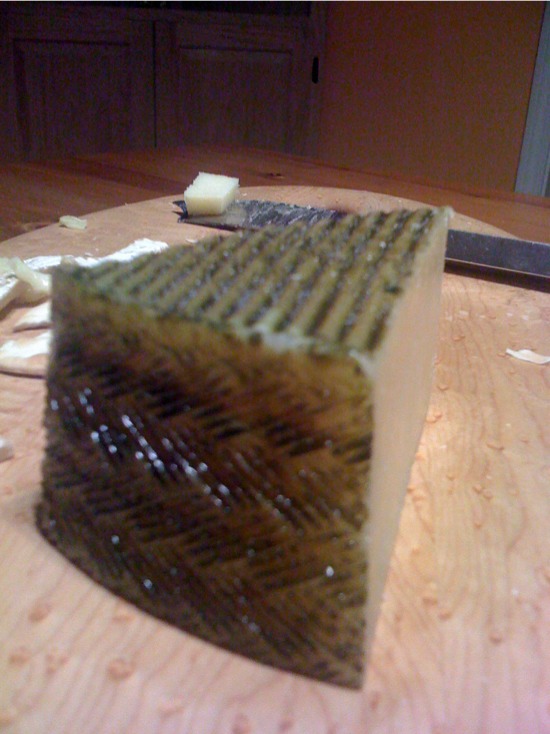 The gorgeous yet far from local Campo deMontalban, a true cheese from La Mancha! I was so impressed with the color and texture of the rind of this cheese that I took another picture. Isn't she pretty? Maybe it's just me, and I need to set up a support group called Turophiles Anonymous. In this economy cheese is one of the most expensive things to buy. But there is no stopping a Turophile, we resist recessions. I think you should do the same and go out and support your local artisan cheese maker!
 Why has it taken me so long to realize that those beautiful vine ripened tomatoes at the market are locally grown!? Backyard Farms grows those wonderful tomatoes year round in the largest greenhouse in New England. They even have native bumblebees inside the greenhouse to pollinate each tomato flower. Bees are struggling these years so it is a win win situation for the bees who then receive their food from the tomatoes’ pollen. I wonder if they will make honey too? Their use of sustainable energy and rainwater reclamation round them out to be one of my favorite discoveries this summer. I do hope that they will not fall prey to the late blight, because I just might have to rely on these beauties for my upcoming tomato sauce project! And better yet, they have recipes on their website! Thank you Backyard Farms for all that you do!
 The Portland Press Herald published this article recently about the localvore simplicity of homemade cheese. I found this article through the blog of the Maine Cheese Collective. I recently published the recipe from Gourmet for homemade mozzarella cheese, but the uncanny timing of this article can't go unnoticed. I just returned from a week long trip to New York City, where I was able to dine on any ethnic food I could choose. From American to Italian to Indian to Brazilian and ending with an American Australian - my final meal one morning in Brooklyn was markedly the best. My daughter's Godmother and I ate in Greenpoint at Five Leaves and it was a treat to say the least. The cafe which opened 7 months ago was financially backed by the late Heath Ledger, another yummy favorite of mine. I chose for breakfast the Sage scrambled organic Eggs
 WHOLE MILK RICOTTA
1 gallon whole milk, pasteurized or raw
1 teaspoon citric acid
1 teaspoon salt
In a large stockpot, combine milk, acid and salt. Heat to 185 to 195 degrees, stirring often. Do not boil.
As soon as the curds and whey separate, turn off the heat. The whey should look somewhat clear rather than milky. Let sit for 10 minutes. Line a colander with cheese cloth and place in a large bowl. Ladle the curds into the cloth. Tie the corners of the cloth together and hang for 20 to 30 minutes.
You can hang the cloth from a knob on a kitchen cabinet or use a wooden spoon through the knot to hang over a deep container.
Eat immediately or refrigerate for up to two weeks.
Makes 3 to 4 cups (11/2 to 2 pounds).

Ultimately, though, I still haven’t answered the question, What is ‘local’ seafood?"


 Posts
All Comments
Posts
All Comments


